Why Your Breeder Matters More Than You Think: The First Eight Weeks Shape Your Puppy’s Future
- Ally Verba
- Mar 22
- 2 min read
Bringing home a puppy tends to make otherwise rational adults behave in very predictable ways. Suddenly you’re deep-diving crate recommendations at midnight, ordering toys your puppy absolutely does not need yet, and convincing yourself that looking at puppy photos for four straight hours counts as “research.”
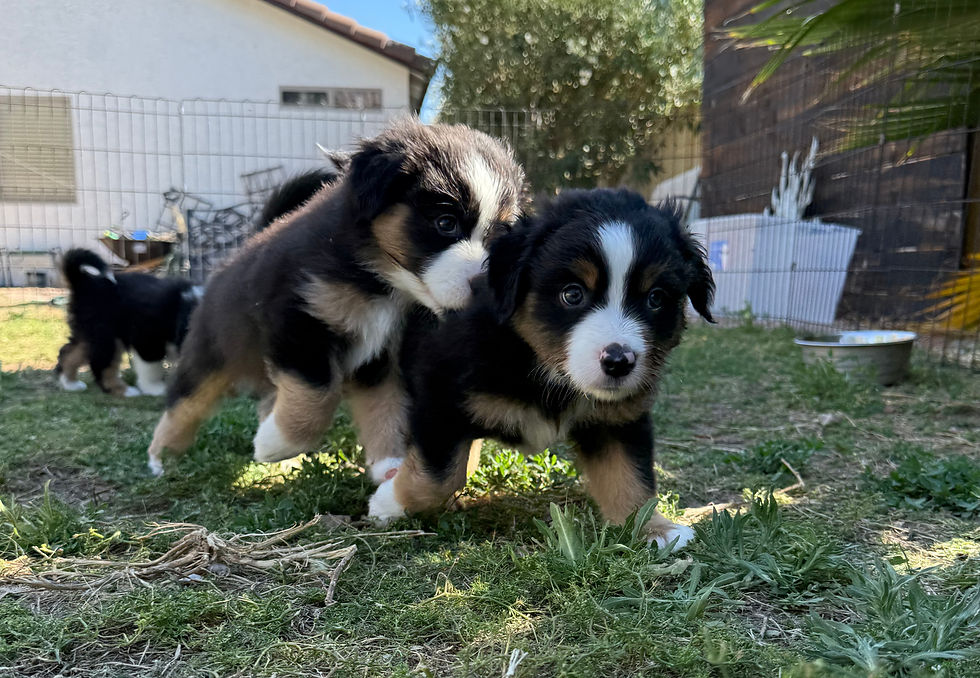
And while most people spend a lot of time planning for what happens after pickup day, very few realize just how much their puppy’s future is already being shaped before they ever come home.
The reality is that your breeder plays an enormous role in who your puppy becomes.
At Outlaw Minis, I spend a significant amount of time focused on the first eight weeks of life because those weeks are incredibly influential from both a behavioral and neurological standpoint. Puppies are born with developing nervous systems that are rapidly building connections and learning how to process the world around them. During this time, they’re forming early associations with novelty, handling stress, recovering from challenges, and learning what feels safe.
That doesn’t mean puppies need chaotic “socialization” experiences where they’re pushed into overwhelming environments in the name of exposure. Your eight-week-old puppy does not need to be marched through a crowded hardware store while strangers grab at them. We can all collectively retire that idea.
Healthy early socialization is far more intentional. It means introducing puppies to new surfaces, sounds, people, environments, and problem-solving opportunities in a way that builds confidence rather than stress. At Outlaw Minis, puppies are raised directly in my home where they experience real-life household sounds, age-appropriate adventures, structured enrichment, safe outings, and plenty of opportunities to learn how to adapt without becoming overwhelmed.
A small amount of challenge can be incredibly healthy for developing puppies. Chronic stress, however, is not. Flooding puppies with too much novelty too quickly can create long-term sensitivity issues, which is why I pay close attention to body language and individual thresholds. Confident puppies may be ready for more. More thoughtful puppies may need additional support. Both are normal.
And then there’s genetics... which honestly deserves far more attention than it typically gets.
Training matters. Socialization matters. But genetics help shape the blueprint we’re working with in the first place. That’s why I prioritize health testing, stable temperaments, sound structure, resilience, and versatility in my breeding program. I want dogs who can excel in sport, adventure, and active homes while also being capable of peacefully existing in your living room without launching themselves into chaos because you dared to sit down.
Revolutionary concept, I know.
By the time your puppy comes home from Outlaw Minis, they’re not starting from scratch. They’re arriving with a foundation that was intentionally built long before pickup day.
And yes, they’re still probably going to steal your socks.
That part is unavoidable.


Comments